
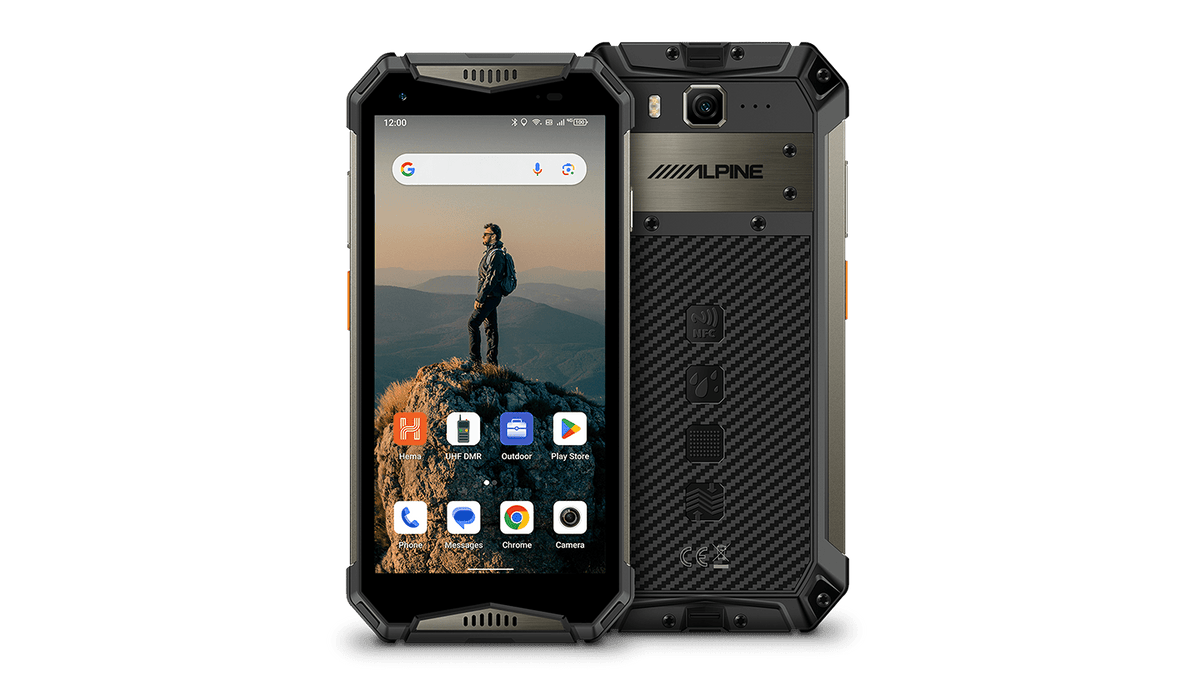
Alpine HX-Z6 Review: Can One Device Replace My Phone, Hema GPS & Handheld UHF?
The Alpine HX-Z6 puts a rugged Android smartphone, Hema navigation and a 2W UHF/DMR radio into one device. Leighton looks at why the concept makes so much sense for touring — and where Android, screen size and radio limitations still get in the way.
I love what this thing is trying to do. I just wish Android and I could agree on where everything lives.
The Alpine HX-Z6 is one of those products that makes more sense the longer you stop comparing it with a normal phone. On paper it is a 5.6-inch rugged Android smartphone. In the real world it is trying to replace three bits of gear I would otherwise carry separately: my everyday phone, a Hema navigator and a handheld UHF.
That is the bit that gets me. Touring setups have a habit of becoming a collection of screens, chargers, mounts, cables and devices that all do one job. The HX-Z6 attacks that problem by putting the useful stuff into one rugged unit that can live in your pocket, sit in the vehicle, come into camp and still do ordinary phone duties when the trip is over.
THE SHORT ANSWER
The HX-Z6 is not the best phone, the biggest navigator or the most powerful UHF you can buy. That is exactly why I like it. It is one rugged device that can do all three jobs well enough to genuinely simplify a touring setup.
If I judged it purely as a $1,299.95 Android phone, I would have a harder time justifying it. Judge it as a rugged daily phone, Hema navigation platform and handheld UHF/DMR radio in one device and the value equation changes considerably.
MY QUICK SCORECARD
- Concept: 9.5/10
- Touring usefulness: 9/10
- Navigation: 9/10
- UHF convenience: 8/10
- Daily-phone usefulness: 8/10
- Android relationship: ongoing domestic dispute
- Value: 8/10 if it genuinely replaces multiple devices
Those scores are my subjective take on where the HX-Z6 fits as a touring tool, not laboratory test results.
WHAT THE HX-Z6 ACTUALLY IS
Alpine and Hema have effectively built a specialist touring phone around Android and then added the stuff that matters once you leave suburbia.
You get a 5.6-inch 2160 × 1080 display, MediaTek Helio G99 processor, 12GB of RAM, 256GB of internal storage, microSD expansion up to 2TB, dual Nano SIM support, NFC and Google Pay, Android Auto, a side fingerprint reader, face unlock, glove mode and the full Google Play Store.
Then the touring side starts to make it interesting: Hema navigation, multi-constellation GPS support, a built-in analogue/digital UHF and DMR radio with removable antenna, a physical PTT button, a massive 10,850mAh battery, USB-C 33W charging, and IP68/IP69K plus MIL-STD-810H ruggedisation claims.
That combination is the reason I keep coming back to it. It is not pretending to be an iPhone with a chunky case. It has been designed around being used outside the office.

WHY I LOVE THE CONCEPT
For me, the strongest argument for the HX-Z6 is not any single specification. It is what I no longer need to carry.
Instead of a phone on one mount, a dedicated navigator on another, a handheld radio somewhere in the centre console and three different charging leads floating around, I can potentially consolidate the everyday jobs into one device.
I also like the fact that the useful parts do not suddenly disappear when mobile coverage does. Hema navigation is designed around touring and offline use, while the UHF is still a radio regardless of whether Telstra has decided the middle of nowhere deserves a tower.
That is what I want from this product. I want it to be the phone I can carry every day rather than another expensive box that only comes out of the glovebox twice a year.
USING IT AS THE EVERYDAY PHONE
If I am going to carry one device every day, it has to earn the right to replace my normal phone. That means calls, messages, apps, payments, Bluetooth, camera, navigation, Android Auto and ordinary life all need to work without me constantly making excuses for it.
The HX-Z6 has the right foundations for that. It runs full Android with Google Mobile Services, so this is not some locked-down proprietary GPS pretending to be a smartphone. I can use the Play Store, banking apps, Spotify, Google Maps, messaging, work apps and the normal things I expect from a modern handset.
Dual SIM is genuinely useful for touring too. Running different carriers can give you another chance at reception without carrying another handset, and the dedicated microSD slot means adding map or media storage does not consume the second SIM position.
Where I would temper expectations is the camera and network spec. A 50MP rear camera sounds great on a box, but megapixels alone do not make it a flagship camera phone. And the HX-Z6 is 4G rather than 5G. That is not a deal-breaker for a touring-focused device, especially once you are somewhere mobile coverage is irrelevant anyway, but at this price in 2026 it is fair to call it out.
ANDROID AND I ARE STILL NEGOTIATING
This is probably the most personal criticism in the whole review. I love the HX-Z6 concept. Android and I, however, are still in counselling.
If you already live in Android, you may wonder what I am complaining about. Coming from an iPhone-style workflow, I can spend an embarrassing amount of time looking for a setting that I know exists, only to discover Android has decided it belongs three menus deeper than I expected.
That is not really the HX-Z6 doing something wrong. It is simply part of the ownership experience for someone who prefers the familiarity of iOS. The upside is that Android gives this device much more freedom than a closed system would: proper file handling, configurable home screens, widgets, navigation apps, offline tools and the ability to install the software that suits the trip.
So yes, Android annoys me. But on a specialist touring device like this, I can also see why it is the right platform.
HEMA NAVIGATION: THIS IS WHERE IT EARNS ITS NAME
Navigation is where the HX-Z6 stops feeling like a rugged phone with gimmicks and starts making sense as a serious touring tool.
The Hema ecosystem is the important part. The device supports Hema Nav and Hema's touring/off-road mapping workflow, backed by GPS, GLONASS, BeiDou and Galileo positioning. That means I am not relying on one mapping app and a mobile signal when I get off the blacktop.
The trade-off is screen size. A 5.6-inch display is fantastic for something that still fits in a pocket, but it will never give you the same map real estate as a larger dedicated navigator mounted permanently in the vehicle. If your priority is sitting back and studying a huge map while driving, a bigger screen still wins.
If your priority is having the navigation device with you when you get out of the vehicle, walk into camp, swap cars or continue on foot, the smaller all-in-one format starts looking a lot smarter.
One thing I would check before buying is exactly which Hema map content is bundled and which content is purchased separately. Hema's ecosystem includes additional map products, so do not assume every map Hema has ever produced automatically lives on the phone out of the box.

THE PTT BUTTON: COMPLETELY NECESSARY, OBVIOUSLY
A physical push-to-talk button will turn otherwise sensible adults into full-blown convoy commanders shouting “copy that, over” in about five minutes. I consider this a feature, not a fault.
Jokes aside, I genuinely like the idea of having the radio built into the same thing already in my hand. Spotting a vehicle through a tight section, coordinating two cars in a convoy, calling someone back to camp or asking whether anybody actually remembered the bloody firewood is quicker over UHF than making a phone call.
The HX-Z6 supports analogue and digital UHF plus DMR, and Hema publishes range claims of up to 10km in open environments and around 5km in urban conditions. Treat those numbers as ideal-case claims, not guarantees. UHF performance changes dramatically with terrain, antenna position, vegetation, buildings and where you are standing.
The other important number is 2 watts. That is useful handheld power, but it does not magically turn the HX-Z6 into a proper 5W vehicle-mounted UHF with an external antenna.
For everyday convoy chatter and portable comms, I love it. For serious remote touring where maximum range matters, I would still have a quality 5W vehicle radio installed. The HX-Z6 complements that system beautifully; I would not pretend it replaces it.
WHAT IT DOES NOT REPLACE
The easiest way to oversell a product like this is to act as though “three devices in one” means there is no reason to own anything else. I do not see it that way.
- A proper 5W vehicle UHF: if maximum radio range and a correctly positioned external antenna matter.
- A satellite communicator: UHF and 4G are not substitutes for satellite-based emergency messaging when you are properly remote.
- A large-screen navigator: if your priority is maximum map size rather than portability.
- A flagship camera phone: if photography and video quality are central to why you buy a handset.
That does not diminish the HX-Z6. It just puts it in the right lane.
BATTERY LIFE AND RUGGEDNESS
The 10,850mAh battery is enormous compared with a normal smartphone, and it makes sense because this device may be navigating, running Bluetooth, acting as a radio and doing ordinary phone work in the same day.
Hema publishes claims of up to 600 hours standby and 39 hours talk time. As always, real battery life depends on screen brightness, GPS use, radio traffic, signal strength, apps and temperature, so I would treat those as manufacturer best-case numbers rather than an expectation for every trip.
What matters more to me is having enough battery headroom that I am not nursing the phone through a day of navigation because I also need it for comms later.
The IP68/IP69K and MIL-STD-810H claims are also exactly the sort of specification a touring handset should have. I want something that makes sense around dust, rain, dirty hands and a 4WD interior, not a delicate glass slab I am terrified to put down on a rock.
The obvious trade-off is bulk. A battery this size plus proper ruggedisation is never going to feel like a wafer-thin city phone. For me, that is a trade I am comfortable making if the device is actually replacing other gear.
THE THINGS I WOULD THINK TWICE ABOUT
- 4G rather than 5G: acceptable for the touring mission, but dated compared with mainstream premium phones.
- Bluetooth 4.2: another specification that looks old in 2026.
- 5.6-inch screen: brilliantly portable, less impressive if you want a huge in-car map display.
- 2W UHF: very convenient, but know what it can and cannot replace.
- Android: powerful and flexible, but there is a learning curve if you live in the Apple ecosystem.
- Map inclusions: check what is bundled versus what Hema sells separately.
- Price: it only makes sense if you value the integration rather than comparing it with a normal handset spec-for-spec.
IS $1,299.95 TOO MUCH?
As a $1,299.95 Android phone, it is hard to call cheap.
As a rugged phone, Hema navigator and handheld UHF living in one device, the maths gets considerably more interesting.
That is the only way I would assess the value. If you already own a phone you love, a big Hema navigator and a quality handheld radio and you are happy carrying all three, there is no magic financial argument that says you must replace them.
But if you are building a touring setup from scratch, want to cut down the amount of gear you carry, or specifically want one rugged daily device that follows you from the driver's seat to camp, the price becomes much easier to understand.
WHO I THINK IT SUITS
I would seriously look at the HX-Z6 if:
- you want one rugged everyday device rather than three separate bits of touring electronics;
- offline Hema navigation matters to the way you travel;
- having a physical UHF/PTT function in your pocket is genuinely useful;
- you move between vehicles or spend time away from the driver's seat;
- you value battery capacity and ruggedness more than a paper-thin handset;
- you are already comfortable with Android — or, like me, prepared to swear at it occasionally until you are.
I would probably skip it if:
- you mainly want the latest 5G flagship phone experience;
- you need the biggest possible navigation screen;
- you expect a 2W handheld UHF to replace a full vehicle radio;
- you have no interest in Hema navigation or touring-specific functions;
- you are completely unwilling to move away from an iOS workflow.
MY TAKE
The HX-Z6 is not the best phone, the biggest Hema navigator or the most powerful UHF you can buy. That is actually the point.
It is the one device I can put in my pocket that brings all three jobs together, and for touring that is far more interesting to me than winning any one specification sheet.
I genuinely love the concept. The huge battery, rugged body, Hema navigation, dual SIM and physical UHF controls all make sense for the way a touring device gets used. I also like that it can still be a normal smartphone once the trip is over rather than becoming another expensive piece of gear sitting in a drawer.
Would I change things? Absolutely. At this price I would rather see 5G and newer Bluetooth. I would never sell the 2W UHF as a replacement for a proper 5W vehicle setup. And I am still waiting for Android and me to reach some sort of peaceful settlement.
But I like the HX-Z6 enough that I am prepared to meet Android halfway. I just reserve the right to swear at it while I am looking for a setting that was definitely somewhere else five minutes ago.
And yes, I will use the PTT button far more than any grown adult reasonably should.
Copy that. Over.
VIEW THE ALPINE HX-Z6 AT AEC →
Review note: This Field Notes piece reflects how I assess the HX-Z6 as an everyday touring tool and the workflow I want from it. Product specifications and range claims are based on Alpine/Hema published data; radio performance varies with terrain, antenna and conditions. Independent long-term public coverage of the HX-Z6 is still limited, so I have not invented a consensus that does not yet exist.
NEED A HAND CHOOSING THE RIGHT GEAR?
Tell us where you are going, what you drive and how you travel. We will help you narrow it down without the sales pitch.
 FIELD NOTE 1
 FIELD NOTE 2
 FIELD NOTE 3