
Darche Cold Mountain Canvas -5 1100 Review: Why Canvas Wins at Camp
Frozen outside and toasty inside. Leighton explains why he only stocks the Darche Cold Mountain Canvas range—and why the roomy 1100 is the sweet spot for swag and vehicle-based camping.
AEC verdict
Quiet. Rugged. Seriously warm. The 1100 just makes sense.
The Cold Mountain Canvas 1100 is the sleeping bag I choose for proper vehicle-based camping. It is warm enough for freezing nights, quiet when you move, tough enough for touring and versatile enough to use as a traditional bag, a doona or part of a joined sleep system.
I will be upfront: I only stock and sell the canvas Cold Mountain sleeping bags. The standard synthetic versions simply are not for me.
I do not like the rustling every time someone moves, they never feel as inviting in cold conditions and they lack the durability and traditional touring aesthetic of canvas. The Cold Mountain Canvas feels like proper camping gear. It is rugged, comfortable, easy to live with and built for the way I actually travel.
What I like
- Genuinely warm in sub-zero conditions
- Quiet canvas outer with no nylon rustle
- Soft cotton-flannel lining
- Spacious 1100mm touring footprint
- Opens fully into a large doona
- Compatible bags can be joined together
- Easy to wipe clean after camp
What to know
- Canvas makes it heavier and bulkier than lightweight hiking bags
- It is best suited to swag, tent and vehicle-based camping
- Your mattress, shelter, clothing and individual cold tolerance still matter
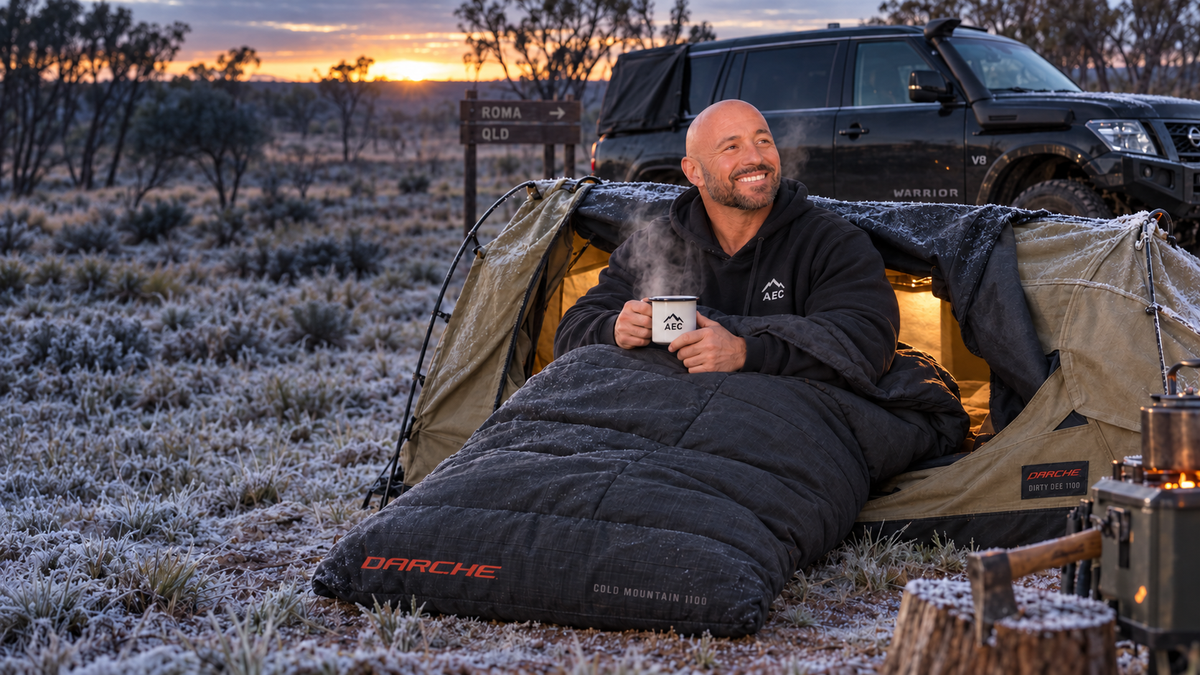
Tested below zero in Roma
On one trip to Roma, the temperature dropped below zero overnight. By morning, the outside of my Darche Dirty Dee swag was frozen over.
Inside, tucked into the Cold Mountain Canvas, I was still toasty warm.
The swag was frozen on the outside. I was toasty warm inside.
That experience told me more than a rating printed on the packaging ever could. When the outside of your swag is frozen but you have slept comfortably through the night, the complete sleep system is doing its job.
I generally use the Cold Mountain inside my Dirty Dee. I have also thrown it onto a self-inflating mattress inside a pop-up hiking tent, and it has performed brilliantly in both setups.

More than a sleeping bag
One of the best things about the Cold Mountain range is its versatility. You can use it as a conventional sleeping bag, unzip the foot for ventilation, open it completely into a large doona or join two compatible Cold Mountain bags together.
Bek and I have used ours opened out like a doona on the Border Track during crisp mornings below 4°C. It gives you that familiar bedding feel without losing the warmth and practicality needed at camp.
It also means the bag is not limited to the coldest nights. Open it up when conditions are milder, share it with the wifey—or accept that Sulley will probably claim a substantial portion of it.
Why the 1100 just makes sense
The Cold Mountain Canvas range comes in 900, 1100 and 1400mm widths, but the 1100 is the one that makes the most sense to me.
At approximately 2350 × 1100mm, it provides plenty of room to move without feeling unnecessarily oversized. It is a genuinely spacious single sleeping bag, works brilliantly inside the Dirty Dee and remains manageable when packed into the Patrol.
The 900 suits campers who prioritise a smaller footprint, while the 1400 gives you maximum room. The 1100 lands right in the sweet spot: generous, comfortable and practical.

Why canvas wins
The 8oz polycotton-canvas outer feels substantially tougher than a lightweight synthetic shell. It also avoids that constant rustle whenever you roll over during the night.
Inside, the 125gsm cotton-flannel lining feels warm and inviting against the skin. The 300gsm dual-layer synthetic filling is designed to distribute insulation evenly and reduce cold spots, while the drawcord chest baffle and shaped hood help retain warmth when the temperature drops.
Canvas is also easier to live with around a real campsite. Dust, marks and dog-related mishaps can usually be wiped away without turning every trip into a delicate exercise in protecting your bedding. It looks better too. Alongside a quality canvas swag, it feels like part of a cohesive touring setup.

The honest trade-off
The canvas construction makes the Cold Mountain heavier and bulkier than a lightweight hiking bag. If you are carrying everything on your back, this probably is not the right sleeping bag.
But for touring, swag camping and vehicle-based adventures, I consider that extra size and weight a worthwhile trade-off for the warmth, space, quietness and durability. This is comfortable camp bedding—not ultralight backpacking equipment pretending to be something it is not.
Which Cold Mountain Canvas size?
| Model | Width | Best suited to |
|---|---|---|
| Cold Mountain Canvas 900 | 900mm | Compact solo touring |
|
Cold Mountain Canvas 1100 LEIGHTON'S PICK |
1100mm | Spacious single and all-round sweet spot |
| Cold Mountain Canvas 1400 | 1400mm | Maximum room and shared comfort |
Dimensions, weights, materials and comfort ratings are manufacturer specifications. Sleeping comfort varies with shelter, mattress, clothing, weather and individual cold tolerance.
Final word
The 1100 is the sweet spot
The Darche Cold Mountain Canvas 1100 is warm, quiet, rugged and properly comfortable. It has kept me warm below zero in Roma, worked brilliantly as shared bedding with Bek on the Border Track and fitted naturally into both my Dirty Dee and pop-up tent setups.
If you want the smallest or lightest sleeping bag available, look elsewhere. If you want durable camp bedding that feels good, works in different configurations and can handle years of touring, the Cold Mountain Canvas 1100 just makes sense.
This Field Note reflects Leighton’s firsthand experience with the Cold Mountain Canvas 1100. Technical specifications are sourced from Darche.
NEED A HAND CHOOSING THE RIGHT GEAR?
Tell us where you are going, what you drive and how you travel. We will help you narrow it down without the sales pitch.
 FIELD NOTE 1
 FIELD NOTE 2
 FIELD NOTE 3